The Art of Precision Terpene Blends for Product Enhancement
Terpene blending is a craft that joins organic chemistry with sensory art. Raw flower extraction leaves the profile to soil, sun and harvest time - engineered blends let formulators set each part by choice. They isolate chosen aroma molecules plus mix them to fixed ratios, giving scent and taste back to distillates, isolates or tinctures that smell of nothing on their own. The once flat product gains a full spectrum of odor but also flavor that greets the user the moment the package opens.
What Defines a Premium Terpene Blend?
A premium terpene blend earns its status through three attributes - pure components, an exact profile and zero synthetic fillers. Makers that aim for quality start with food grade, natural material, either plant material derived terpenes (CDT) or botanical derived terpenes (BDT). They strip out lipids, waxes and other unwanted residue so that only clean terpenes remain. The "premium" label confirms that the final liquid matches the target chemical fingerprint down to the last trace. A top tier "Blue Dream" blend, for example, delivers the same myrcene-to-pinene ratio measured in the living plant, not a rough copy. Reporters who cover the sector plus professional formulators state in unison that a premium product must also stay free of cutting agents like propylene glycol, vegetable glycerin or vitamin E acetate - every vapor draw or sublingual drop keeps its safety and integrity intact.
The Difference Between Single Isolates and Terpene Blends
A terpene blend reaches premium grade when it has pure parts, a precise profile and no man made fillers. Producers who want high quality begin with food safe, natural stock - either plant material terpenes or plant terpenes. They remove fats, waxes and any other unwanted matter so that only clean terpenes stay behind. The "premium" label shows that the finished liquid matches the planned chemical print down to the last trace. A top grade "Blue Dream" blend, for instance, gives the same myrcene-to-pinene ratio found in the live plant, not a rough copy. Writers who report on the field plus trained formulators agree that a premium item must also stay clear of cutting agents like propylene glycol, vegetable glycerin or vitamin E acetate - every puff of vapour or sublingual drop keeps its safety and integrity intact.
Why Formulators Choose a Natural Terpene Blend for Consistency
Formulators put natural terpene blends first so the product stays the same from batch to batch, something raw farming rarely delivers. In plant material , "OG Kush" grown in one harvest often smells unlike the next because small shifts in humidity or light change the plant. With measured terpene mixes, a vape cart or tincture bought in January tastes identical to one bought in July. That steadiness keeps customers - they trust the flavor plus effect to fit their wellness plan and avoid the swings that come with every new crop.
Unlocking the Entourage Effect with Complex Terpene Blends
The entourage effect starts when a mix of terpenes teams up with plant-derived compound to boost or fine tune their healing power. Studies show terpenes do more than add scent - they change how the blood brain barrier behaves and how plant-derived compound receptors respond. A mix high in myrcene, for instance, adds to CBD's sedating action, whereas a mix led by limonene and pinene lifts alertness plus focus when joined with CBG. Formulators who craft such mixes steer the mental or body effects of plant-derived compound, shifting plain intoxication into a purpose built state suited for sleep, calm or creative drive.
Strain-Specific Profiles vs Functional Mixtures
The terpene blend market splits into two camps - one camp copies exact plant material varieties. The other camp builds mixes for clear body targets. Strain copies attract buyers who know classics and want to taste famous lines like "Girl Scout Cookies" or "Sour Diesel" without breaking rules. Functional mixes drop plant names. They print goals like "Deep Sleep", "Focus" or "Libido" on the label. Chemists pick terpenes for pharmacological data, not for ratios found in one plant - products hit narrow aims.
Recreating Classic Plant material Strains with Terpene Blends
Terpene blend makers fall into two groups - one group reproduces the profile of a single plant material cultivar. The other group designs formulas for specific physical effects. Buyers who already know popular cultivars choose the copies to sample the flavour of lines like "Girl Scout Cookies" or "Sour Diesel" while staying within the law. Functional blends leave out plant names. Their labels list aims like "Deep Sleep", "Focus" or "Libido". Chemists select terpenes from pharmacology papers, not from a plant's native ratio - each bottle serves a single stated purpose.
Crafting a Terpene Blend for Sleep and Relaxation
Sedative terpene blends slow the brain - turning down the GABAergic system - the body relaxes and sleep comes sooner. To build a useful mix, pick terpenes that fit tightly to GABA-A receptors, the main brakes of the central nervous system. A monoterpene that appears in large amounts in plant material, is thought to help substances cross the skin and to loosen the blood brain barrier, letting companion plant-derived compound enter the brain more easily. Linalool works on both the glutamatergic system besides GABA receptors, quieting over active neurons. Trials show that those volatile molecules cooperate to cut movement plus bring drowsiness, a joint action often noted in plant material science NCBI/NIH.
Energizing Sativa-Inspired Natural Terpene Blend Options
Sativa-profile blends rely on terpenes that block the enzyme acetylcholinesterase, keeping neurotransmitters needed for focus and alertness available longer. The energizing effects linked to "Sativa" profiles stem from terpenes like Alpha Pinene and Limonene. Alpha Pinene slows acetylcholinesterase, the enzyme that breaks down acetylcholine. This slowdown raises the amount of acetylcholine at synapses, supporting memory retention plus clear thought. Limonene adjusts serotonin (5-HT) and dopamine pathways, lowering anxiety while still supplying stimulation. Formulation science uses high amounts of those monoterpenes to reproduce the elevated, mental effects of certain chemovars but also to avoid the sedative routes activated by denser sesquiterpenes.
Hybrid Terpene Blends: Balancing Flavor and Effect
Hybrid blends use the Entourage Effect to balance receptor activity and avoid heavy sedation or excess stimulation. A hybrid aims to steady the system - activating CB2 receptors, often through Beta Caryophyllene and - engaging multiple TRP channels. Beta Caryophyllene acts as a dietary plant-derived compound that locks onto the CB2 receptor, easing inflammation and anxiety without mind altering toxicity. When Limonene lifts mood besides Humulene adds a grounding note, the blend adjusts the "fight or flight" response. The body reaches an even state that keeps the user calm but clear headed. More information on how plus terpenes work together appears at NCBI/NIH.
Applications for Vapes, Tinctures, and Topicals
The speed and strength of a terpene blend depend on how it enters the body and on the way the body handles it once it arrives. If the blend is inhaled, swallowed or placed on the skin, each path crosses living membranes in its own way. Inhalation acts fastest, because the pulmonary alveoli give the vapour a large surface plus the vapour moves straight into the blood. Swallowing sends the terpenes through the liver first - liver enzymes change part of the dose - less active material reaches the general circulation. A cream or patch lets the molecules drift through nearby skin layers without entering the blood in large amounts. People who design products must keep those different paths in mind so that the chosen dose form lines up with the effect they want.
Optimizing Viscosity in Vapes using Terpene Blends
Terpenes work as natural thinning agents - they change the flow behaviour of plant-derived compound distillates so the oil vaporises correctly without man made additives. In a vape cartridge, viscosity decides how fast the liquid passes through the small opening and how it meets the heater. Terpenes are light volatile organic compounds. When they mix with heavy plant-derived compound oils like Delta-8 or CBD distillate, the overall thickness drops. The thinner oil moves more easily and turns into vapour at a lower temperature - heat damage to the active compounds is less likely. The amount of terpenes must stay within a set range. If too much is present, the vapour becomes harsh and, at high voltage, can break down into unwanted chemicals like methacrolein.
Infusing Tinctures with a Natural Terpene Blend for Flavor
Terpenes raise the fat loving nature of oil tinctures and start absorption under the tongue. In a tincture, they give both flavour plus better uptake. Because terpenes love fat, they mix easily with MCT oil. The same fat loving trait helps pull plant-derived compound through the thin skin below the tongue and later through the gut wall. Terpenes also plug into TRP taste channels, hiding the bitter, soil like note of raw extract but also setting off the body reply linked to that terpene set - eucalyptol, for example, gives a cool feeling.
Enhancing Topicals and Salves with Terpene Blends
Terpenes help active ingredients pass through the outer skin layer. They loosen the stratum corneum so molecules move farther. The skin blocks most foreign substances because its surface lipids line up tightly. Limonene and alpha pinene disturb this order for a short time. The diffusion coefficient rises plus large plant-derived compound molecules reach nerve endings and receptors in the dermis but also fat layer. Reports show that terpenes act as skin penetration enhancers NCBI/NIH.
Creating Signature Aromatherapy Products with a Terpene Blend
Terpene blends let you shape an aromatherapy session so it smells like a well known plant material strain but stays free of any high. You drop the blend into a diffuser, a candle or bath water - the aroma nudges the mind toward calm, alertness or vigor. While you build a product line, you rely on the terpenes’ scent to deliver the intended "entourage effect" without any other aid.




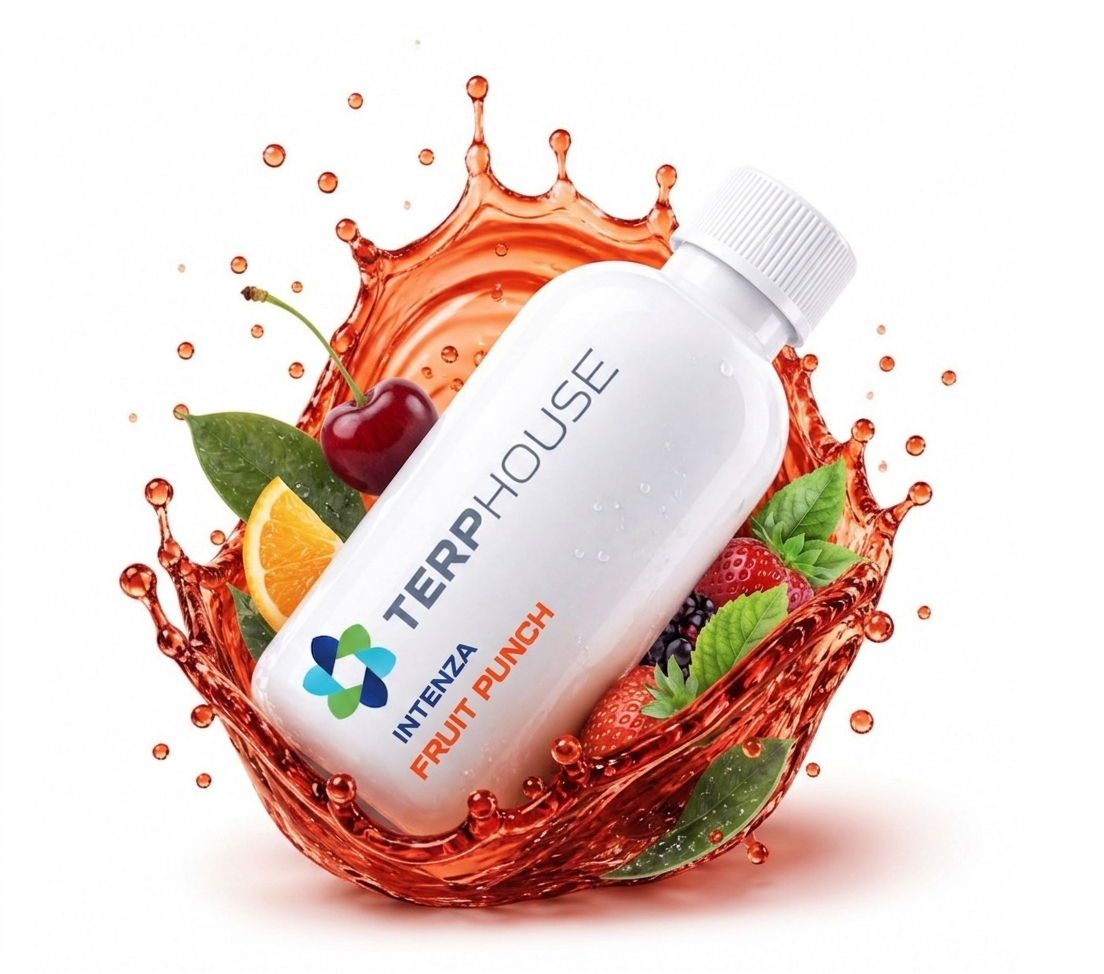
 Fruit Punch INTENZA